Sunday, December 6, 2020

Taiwan Dong Ding Oolong Tea, History, Processing & How To Brew

 Oolong tea is what Chinese people favorite, especially popular in Fujian Province. Taiwan, the province only an ocean away from Fujian, the oolong drinking culture also profound. Dong Ding oolong tea is famous which originated there and is regarded as “holy of tea.”

Dong Ding Oolong Tea Origin And History

Dong Ding oolong tea is originated in Lugu town, the middle region of Taiwan. And there is a mountain called Dong Ding; the earliest Taiwan oolong tea was birth from the tea trees there. “Dong” means cold in Chinese, and “Ding” means the top. That doesn’t mean the temperature there is cold or the mountain top is frozen. In fact, the climate there is warm all year round.

The real meaning of “Dong” is one pronounce of the local language, which means “stand on tiptoes.” Because the mountain is heavily foggy, the road is wet and steep. People need to stand on their tiptoe to walk when they go picking tea and avoid falling down.

The ancestors of most Taiwan people were migrated from Fujian at the late Ming Dynasties(1368 to 1644) because of the war. So now, most Taiwan people take the Fujian dialect(Hokkien) as their daily language.

A story about Dong Ding oolong tea origin happened in the Qing Dynasty(1644 to 1912). A Lugu town student named Lin Feng Chi wanted to go to Fujian and take the exam, but he got no money. The villager pool money for him as the traveling expenses and hopes he can bring something back from hometown, to relieve their homesickness.

Lin Feng Chi finished the exam successfully and be an official. A few years later, he planned back to Taiwan. He picked 36 Qingxin type Camellia Sinensis from Wuyi mountain and bring them back to Taiwan. 12 tea trees of them were survived and planted in the Dong Ding mountain. After a long time of cultivation, they grow into a large tea plantation. People also use Fujian traditional tea processing methods on tea-producing, then the Dong Ding oolong was born.

Phoenix, Yonglong, and Dong Ding lane villages of Lugu town are the 3 main producing regions of Dong Ding oolong tea in Taiwan. The tea plantations are located at about 800 altitude meters, foggy and warm, suitable for tea trees growing. Many times people also regarded Dong Ding oolong as high mountain tea, but it isn’t right.

High mountain tea means the tea from the plantations at an altitude of over 1000 meters. But due to the Dong Ding tea brand is famous, and there are lots of plantations over 1000 meter altitude in Taiwan. So people usually call all the oolong tea from Taiwan as Dong Ding, some of them really belong to high mountain tea. Of course, the Alishan Cha and Oriental Beauty tea from Taiwan also famous.

How Dong Ding Oolong Tea Processing

The processing of Taiwan Dong Ding oolong tea is similar to the Tieguanyin tea. Still, Dong Ding emphasizes the roasting more, so the aroma of them has a significant difference.

Picking

Dong Ding tea can be harvested all year. The picking standard is one bud, and the second to the third leaf, the best picking time is 10 am to 2 pm.

  • Spring tea: late March to late May;
  • Summer tea: late May to late August;
  • Autumn tea: late August to late September;
  • Winter tea: late October to late November;

Withering

After picking, the leaves need to be sun withering for several hours, let the water evaporate, and make the body soft. Even though it doesn’t need to care about the strong sunshine, the temperature better stays lower than 40℃. Sun withering also can help to remove the herbaceous smell.

Tossing

Tossing is the most essential step in oolong tea processing. Leaves after withering, the tea masters will put them a rest indoor for a while to let them cool down. Then begin tossing.

Tea masters put the leaves on a big bamboo sieve, tossing and make them crash each other. The edge of the leaves will break, the broken part will oxidation faster and turn red. The juice also outflows and cover the body, to create more taste when brewing. That’s why oolong tea is called partially-fermented tea.

Typically, placing and tossing will alternate several times. In this way, the tea master can identify the fermentation degree of tea better. And the Dong Ding oolong tea also classified into three levels according to the fermentation degree:

  • Light fermented: about 20%;
  • Middle fermented: about 40%;
  • Heavy fermented: about 70%;

Fixation

To process Dong Ding oolong needs to take fixation to stop the leaves from going on fermenting. In traditional, tea masters will do this job in a pan-frying way, that easier to control by their rich experience. 

In modern, people will finish the job by machine. Fixation stops the leaves from fermenting and can remove the herbaceous smell and create some cooked aroma.

Rolling

Rolling is to shaping the Dong Ding oolong tea. One thing different from the other tea types is that the local authority demands that Dong Ding tea must be rolling into a ball shape. 

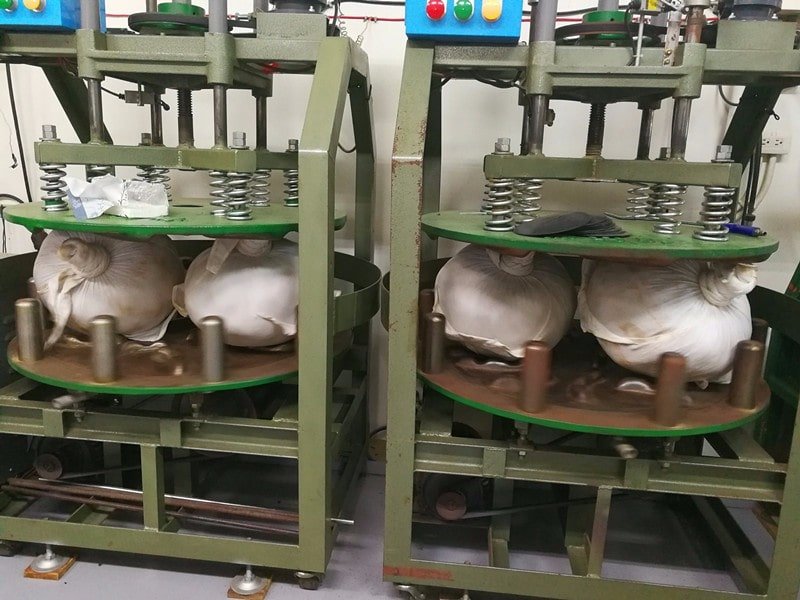
The leaves after fixation, tea masters will put them into a special cloth bag, then rolling by a machine or by manual. During the processing, it needs to open the cloth bag several times for radiating. The leaves’ body’s shape will change into a ball after repeated times, different from the common strip-shape tea we saw.
Roasting

Roasting is a significant step to decide the Dong Ding oolong tea fragrance-type. During processing the Dong Ding tea, rolling and roasting jobs are alternated. As for the specific method, every tea manufacturer has its own secret.

Because oolong tea has not been completely fermented, the sugar and amino acid it retains will be caramelization when roasting, thus creates various fragrances.

Some tea lovers like to store Dong Ding oolong tea and take them out re-roast every year, to make the taste stronger. So there is a saying about Dong Ding tea is “middle fermented and heavy roasting.”

Dong Ding Oolong VS Tieguanyin

Even though all oolong tea originated in Fujian, people prefer to compare the Dong Ding tea and Tieguanyin more, but not the Wuyi Da Hong Pao tea. Because Dong Ding oolong and Tieguanyin looks similar. Make clear the differences between them, and you will not confuse when buying.

Dong Ding oolong tea VS Tieguanyin tea

Origin

Most Tieguanyin and Dong Ding oolong tea are made from the Qingxin type Camellia Sinensis, but the regions they grew are different. Tieguanyin mainly from Anxi, Fujian, and Dong Ding tea is from Taiwan. About the plantation’s altitude, Anxi belongs to the plain, and Dong Ding mountain belongs to the medium height. Typically, teas from the high altitude plantation are better in flavor and richer in benefits; but the gap won’t be large. 

What is worth knowing, in recent years, many tea merchants from these two places, sending the raw tea to the opposite side for processing. Then named the products with the local brand, to cheat the customers.

Color

Because of the different fermentation degrees (Tieguanyin is about 10%-30%, Dong Ding oolong tea is about 20%-70%). In most cases, they got a different color. 

Tieguanyin, due to the low fermentation degree, shows dark green; Dong Ding oolong tea fermented deeper and has been over and over roasting, so it shows brown. Still, some low fermented and roasting Dong Ding oolong tea hard to distinguish from Tieguanyin by the color.

Appearance

Both of Dong Ding oolong and Tieguanyin tea are ball shape. But if you look carefully, you will found that the Tieguanyin leaf is a spiral curl. And the picking standard of Dong Ding tea is one bud, second to the third leaf; Tieguanyin only picks the second and third leaf, not buds contain. 

Besides, due to the different picking methods, Dong Ding oolong typically contains more stem in the products than Tieguanyin. That may because, in China, the Tieguanyin tea stem can be the independent sale to the low-end restaurant for serving customers.

Fragrance

The Tieguanyin tea dry leaves are with an orchid aroma; after brewing, it will be stronger and tastes a little sweet. Dong Ding oolong tea is with a strong roasting fragrance; after brewing, it will send out huge osmanthus or fruit fragrance.

After all, even though these two types of tea look similar, but they taste totally different. Both of them are worth to have a try.

How To Brew Dong Ding Oolong Tea

To brew Dong Ding oolong tea, use a porcelain Gaiwan may be more suitable.

  1. Preheat the teawares;
  2. Take about 5g Dong Ding oolong tea into the Gaiwan, just full the bottom;
  3. Fill in some hot water to preheat and wash the tea, then pour out the wastewater soon;
  4. Add 95℃ or higher hot water in for steeping. A novice can add water against the edge of Gaiwan. And the veteran can have a try on “high brew” way, which can make a stronger fragrance;
  5. Cover and steep for about 15s, then pour out the infusion into a fair cup;
  6. Serving;
  7. Oolong tea got a feature that is resistant to brew, and Dong Ding oolong tea typically can make over 5 infusions. The steeping time of the following infusion should add 10s in turn.

Baihao Yinzhen(Silver Needle Tea) Processing, Taste & Aging

 People who love white tea should ever hear about Baihao Yinzhen tea. The plump leaves will vertically suspend at the water when brewing, what an imposing vision. But Baihao Yinzhen tea belongs to the highest-grade white tea, it is costly and hard to buy. A few years ago, it was even out of stock.

What value does Baihao Yinzhen get, and why it gains popularity even with such a high price? Let’s see.

What Is Baihao Yinzhen Tea

A more well-known name of Baihao Yinzhen is Silver Needle tea. This name is from its straight leaves, spiky like a needle, and the body is full of white fuzz, shining silver bright under sunshine.

Baihao Yinzhen tea originated in Fuding producing region, Fujian province of China. Here also is the birthplace of white tea. All the white tea produced here is made from a kind of Da Bai Camellia Sinensis, only been picking, withering, and drying processing. Compared to green tea, it is closer to nature, and the nutrition facts it contains are richer.

Do you remember the other post we’ve to talk about the Moonlight White Tea(here)? Although it processing as same as the traditional white tea, its leaves are picked from the Yunnan Big Leaf Camellia Sinensis, so many tea lovers do not think it belongs to white tea.

Baihao Yinzhen, white peony, and Shou Mei are all from Fujian city, total terms by name Fuding Da Bai Cha. Among them, Baihao Yinzhen tea is regarded as with the highest quality because it only picked from the earliest and tendest buds in every spring. It is just like Longjing Tea, which is the highest class of green tea.

It is recorded that white tea was invented in the early years of Jiaqing in the Qing Dynasty (AD 1796); the beginning name is Luxueya(green snow buds), and the mother tree still growing in a local tourist area. 

In the past, this high-grade tea only offers to the emperor, later export for the Europen nobles, and it became a status symbol. But the silver needle tea is too expensive and rarity, the nobles only put some in the black tea they brewed for serving. It is actually a more wasteful choice. Even now, British people still love white tea deeply.

How Baihao Yinzhen Processing

White tea has been the least processing of all tea types, but it is not easy, especially the Baihao Yinzhen tea. That is the reason why it got a high price.

Picking

Baihao Yinzhen tea’s picking job is from half a month before the Qingming Festival(a Chinese festival, typically on April 5th) come, till to few days before the festival, only got about dozen days. This period is when Da Bai tea trees growing new leaves, the tenderest buds break out off the shell. Pay attention; I used the word “shell” in this sentence, and this “shell” is a unique characteristic only Baihao Yinzhen tea has.

If we take a careful look at the silver needle tea leaves, we will find the bud consists of two-piece leaves, not only one tender leaf. The smaller leaf is the shell, also called the Kylin scale. Due it is connected with the bud, so it can’t be removed, or it will break the bud-body. The shell and bud make the unique shape of Baihao Yinzhen tea; people in the industry called it “one flag, one spear.”

Once miss the best picking time, the shell will grow up to a leaf. And as a result, this bud’s quality class reduces one level directly, and cannot be made into Baihao Yinzhen anymore, only can making into White peony tea. After we buy some silver needle tea and found it just got one bud, that may mean it is not made from the first-picking leaves that year.

Sometimes caught terrible weather, the time for picking will be shorter. That short picking time makes the low yield; it’s the first reason for the high price.

Withering

Not like other tea types, after picking, white tea does not need to be fixated and rolling, only taking withering for a light fermentation purpose. Because the natural leaves have not been any physical damage, so the final product keeps the whole shape. And the tiny white fuzz is retained, cover on the green body, make it looks white. That is why it is called white tea.

Withering is classified into indoor withering and sun withering. During the Baihao Yinzhen processing, it typically takes more than 60 hours, so indoor and sun ways are alternating runs.

The withering job looks simple, but actually, it is very troublesome. Because this job entirely relies on how the weather is, and the weather is uncontrollable. 

So when doing the sun withering, tea masters should let the leaves avoid direct strong sunlit, or the leaves will turn red and affect the quality. When at night, they should put all the leaves indoors, where the place is cool, dry, and ventilated. Because the weather outdoor at night is humid, it may make the dry leave absorb the moisture again and go bad.

Withering makes the component contained in tea got to transform, to form some sweet taste, and to evaporate most of the water. Likewise, if caught the rainy days, the whole withering job can only be done indoor; it leads to the product being not as good. So, if the tea master forecasts that the coming days will be rainy, they will prefer to put off the picking day. That is the second reason for the high price.

Drying

Even though during the withering, most of the water contained in the leaves has evaporated, it still can not reach an ideal water content standard. The Chinese gov demands that white tea’s water content must lower than 7%; this is a loose standard, but still not suitable for long time storage. So the tea masters finally will take a drying job to the white tea, make the moisture content of it reduce to 3%-4.5%.

In the traditional, Baihao Yinzhen will be drying in a roasting way, just like the other tea types. Roasting not only drying the leaves but also make the sugar and amino acid contained in leaves caramelization, promotes the fragrance and flavor further. In the past, people usually took carbon roasting because there is no electricity.

Although carbon roasting looks more traditional and natural, it is a difficult job. So in modern times, most of the tea master will choose the electric roasting, which is easy, efficient, and high yield.

Types Of Baihao Yinzhen Tea

Except for Fuding producing region, there is another famous region called Zhenghe that also produces Baihao Yinzhen tea. People called the Baihao Yinzhen from Fuding as North Road Silver Needle, the one from Zhenghe as South Road Silver Needle.

North Road Silver Needle. Typically, the Baihao Yinzhen we talk about is the north road silver needle from Fuding. The feature of it is the plump shape, rich fuzz, and full shiny. It tastes partial to fresh, with a strong so-called “pekoe fragrance.”

South Road Silver Needle. The south road silver needle from Zhenghe producing region is not as famous as the north one. It looks thinner and longer, much like a needle than the north one. But it got fewer fuzz and darker color. It tastes much partial sweet and mellow. Compared with the north road silver needle, the biggest pro of it is a lower price.

Worth to know, it can not say which one is better. Although south road silver needle tea is not so famous, it doesn’t mean it is not a good tea. And about the flavor, everybody got different tastes.

How To Aging The Silver Needle Tea

What we know that some teas can get a better flavor through aging, such as Pu-erh tea and moonlight white tea. All of them have a characteristic that is compressed into a tea cake for sale. To Baihao Yinzhen tea, it is sold in a loose tea way. Because of compression will break the iconic shape and fuzz. So here comes a question, is Baihao Yinzhen suitable for aging?

The answer is YES.

To white tea, there is a saying, “one year is tea, two years is medicine, three years is a treasure.” That says white tea can bring more health benefits after a long time of aging. Of course, the price also expensive like a treasure. But there are two premises; one is the tea should be stored properly, another is only the high-quality white tea is worth aging.

As previously mentioned, some Baihao Yinzhen tea, which hasn’t dried enough, is not suitable for aging. Because it still contains much water, it tastes no difference when it is still new. But after long time storage(more than 2 years,) it may be gone moldy, form a sour and musty taste. What a funny thing is, some tea lovers thought it is a plum flavor and called it plum fragrance type.

The high-quality Baihao Yinzhen tea will send a kind of aroma called “pekoe” when brewing; it smells close to some wild reed and Setaria, also with a little floral. After a long time aging, the flavor of old silver needle tea will change into something close to ripe cereal, with a bit of dry wild grass smell. The longer it aging, the stronger the ripe flavor it got. And the color of infusion will turn from light yellow to amber.

Some tea lovers ever said, after aging more than 40 years, the Baihao Yinzhen tea will taste like a strong Chinese medicine aroma, with a little lotus leaf fragrance. That sounds not real to me; few people really get a chance to drink the white tea which has been so long aging.

And how do we aging the Baihao Yinzhen properly?

It is not like we talk about Liu Bao dark tea aging way on the previous post. Baihao Yinzhen doesn’t belong to post-fermented tea, so during aging, it should avoid contacting the air, prevent it keep fermenting. Before storage, we should twist the leaves with fingers. If it breaks into powder, that means dry enough; on the contrary, it is not suitable.

At first, we need to pick the right tea storage container, the porcelain one is what I highly recommended. After putting the Baihao Yinzhen loose tea into the porcelain container, it’s better to seal a brown paper at the opening and then cover. Finally, use another brown paper to pack the whole container off.

Related Reading: How To Pick A Suitable Tea Storage Container.

The place for aging Baihao Yinzhen should be cool, dry, and dark, and avoid to store it with any other smelling thing like perfume. Otherwise, do not often open the container to see how the tea change; try to control your curiosity. Every time after you take some teas out for brewing, pack it well again follow the previous steps.

How To Brew Baihao Yinzhen Tea

To brew Baihao Yinzhen tea, more if for watching the interesting vision that the leaves vertically suspend in the water. So it is best to use a glass teapot for brewing, or a glass cup.

  1. Pre-heat the teaware;
  2. Take moderate Baihao Yinzhen, typically the ratio of tea leaves to water is 1:50, put them into the teapot;
  3. Add 80℃ hot water in, till 1/3 of the teapot, steep the leaves for about 10s;
  4. Go on adding hot water till 4/5 of the teapot, cover, and steep for about 1 min;
  5. Serving and enjoy;

P.S. 

  1. In the first infusion, the Baihao Yinzhen leaves will vertically suspend at the top of the water. And at the next infusion, some of the leaves will slowly fall down to the bottom and create an up and down stagger vision. If you use a glass teapot for brewing, and some sunshine just through the window, you will see an awesome picture inside the teapot.
  2. When you add hot water, you need to pay attention to it; do not use the “high-brew” way; it will crash the fuzz on the silver needle off and make the infusion muddy. You should add water from the edge of the teapot opening slowly, avoid letting the water crash on the leaves directly.

How To Use A Fair Cup To Help Making Tea?

 We often see a little pitcher in the complete set teawares for sale; its official name is Fair Cup. What justice can it bring to us? Let’s see.

What Is Fair Cup Use For

When a tea ceremony novice is serving his guests, he may make a condition of flavor inequity. Each guest gets a different taste from the tea he made. 

The fair cup is for solving this problem. Cha Zhong, Cha Sea, and tea pitcher are its other names.

When we make tea, no matter loose tea, tea cake, or tea bags, a teapot is necessary. If you use a glass teapot, you will see the tea component dissolve into the water slowly. To different types of teas, needs different steeping time to get the best flavor.

But, by the increasing steeping time, we will found that the infusion will be layering in the teapot because of the different concentrations. The closer to the bottom, the darker it will be, which means it tastes stronger. If you pour it into the teacups directly, each guest will get different concentration tea. And they got a different tea experience, that is not fair.

Here comes a good demonstration from Sonia of helloteacup. She uses an ordinary traditional Gongfu Tea Ceremony little teapot to make tea. The first cup and the last cup, the infusion they got, has a 100% steeping time gap. So they have an apparent concentration discrepancy.

If you gonna enjoy tea alone, this discrepancy will bring better tea experience, but it is terrible when serving guests. When making fruit tea or bubble tea, we can solve this problem by stir or shake the teapot. But it is not graceful in the traditional tea ceremony, and nobody will do this.

So we need a fair cup. After enough steeping time, pour the tea infusion into the fair cup first. Therefore the different concentration layers will mix, unify the concentration and flavors. Then pour the tea to the guests’ teacup from the fair cup, to make them get the same tea experience.

Some veteran tea lovers also can judge the tea quality by the color when having tea. Due to the fair cup with a bigger opening and no cover, people can clearly see the tea color. So that it will not make an awkward case, found the tea quality is not good until serving tea to guests.

To a novice, it’s not easy to master how much tea leaves should take, and the steeping time; that lead to making the tea concentration too high or too low. 

Under this case, we can pour the infusion into the fair cup slowly and watch the color. Once the concentration is low, pouring slower to let the leaves steep longer. If the concentration is too high, we should stop pouring and add some water for diluting. Even though it is not a graceful method, but to a novice, it can help avoid wasting the tea.

Using a fair cup can help cool the tea to some extent and make it suitable for drinking. Besides, it can also help sediment the delicate leaves which the teapot hasn’t filter.

Common Fair Cup Types

During making tea, the fair cup plays a role of transfer and mix the infusion. Although this process is short, it still has some effects on tea quality. The fair cup contains in the complete teaware product, typically got the same material as other tea sets. But we still can pick one extra fair cup as loved.

Glass

The glass fair cup is the most common and popular type. It has a pro that others not. It can help watch the tea color clearly to judge the quality, and whether the concentration is fine. You can also know how much tea left, more conveniently to serve the same volume of tea to each guest, to give fairer treatment.

Porcelain

The porcelain fair cup also common, especially the white porcelain one. It’s the same as the glass fair cup, can help watch the tea color, but not to convenience as the glass one because it is not lucency. Compared with the glass one, porcelain fair cup is stronger, not easy to break by suddenly heating, and easier to clean.

Pottery

Most of the Gongfu tea set is made from pottery, especially from purple sand. Some in the complete set sales products, the fair cup also made from pottery. But in fact, pottery not seems suitable. Because it is not transparent, and it is typically dark color; that affects watching the tea color.

Related Reading: What Is The Difference Between Pottery And Porcelain?

How To Use Fair Cup In A Right Way

  • Avoid Overflow. There is a “high-brew” skill of making tea, which can better extract the tea flavor. But when we pour the tea from teapot to the fair cup, we should take a suitable height to avoid the tea overflow and get a burn. Likewise, when pouring the tea from the fair cup to teacups, make them close enough.
  • Keep Tidy. As a host, it is inevitable to wet the tea tray when making tea, especially brewing in the Gongfu tea way. So when we serve tea to guests’ teacup, we should use a towel to dry the bottom of the fair cup and avoid letting the water drop on the guests’ table.
  • Equal Distribution. Except for letting the guests get the same flavor of tea, the volume should also be the same. There is a rule in the traditional tea ceremony when serving tea, never fill the teacup full. Typically just till 7/10, filling full is disrespectful to the guest. Besides, the host needs to pay attention to whether the guest finishes drinking and re-fill the tea in time.

An interesting thing worth saying, even though the fair cup regarded as a standard configuration on a Gongfu tea set, and Gongfu tea culture originated in Chaoshan, China. But when local people brewing tea in Gongfu tea way, they will not use a fair cup.

They solve the different tea concentration problems is to arrange the teacups in a circle, then serving tea in a drawing circle method, but not serving a cup by a cup. This skill is called “Guan Gong Xun Cheng.” It’s a story about a Chinese ancient general go on patrolling cities.

A veteran tea master can easy to make every teacup got the same tea. Once the teacups got not the same tea volume, they will add more tea in drop by drop till the same. This skill is called “Hanxin Dian Bing,” from a story about an army adviser checking his soldiers’ number.

Related Reading: How To Make Tea In Gongfu Tea Way.

How To Pick A Suitable Fair Cup

  • Material. As previously mentioned, three common material of fair cup, glass, pottery, and porcelain. Among them, I highly recommended the glass one.
  • Size. When choosing a fair cup, pick one which has a little bigger capacity than the teapot you use. So that no tea left behind in the teapot, avoid making the leaves keep cooking. But the size should not be too big, or it will occupy the space of tea tray and not comfortable to hold.
  • Shape. The shape of the fair cups is various. Total saying, it can be classified into two types, with handle or not. The one with a handle will easier to hold, especially for the novice. And the no handle one typically has a good looking, but a little hard on hold.
  • Smooth Output. The fair cup has no cover, so the spout design is important(some physical reasons.) When you are going to pick a fair cup, scrutinize the flow, whether smooth and balance. Besides, see the water whether it will flow down from the spout when stopping pouring tea, which will affect the table’s cleanliness.

Sunday, November 22, 2020

Phoenix Dan Cong Tea – History, Processing & 10 Fragrance Types

 Tea originated in China, drinking tea is a part of Chinese life. Even though there were vast types of tea, and different places prefer different tastes. But among them, oolong tea is no doubt has most fans. Phoenix Dan Cong tea, a kind of famous Oolong from Chaozhou city, is becoming a trend in recent years.

In my impression, Chaozhou has the most drinking tea atmosphere in China. In the previous post(here), we’ve talked about the Chinese Gongfu Tea Culture. Which was birth in Chaoshan, tea drinking has become a part of Chaoshan people’s life at all. They even can not imagine not having tea in a day. 

One of my friends, from a traditional Chaozhou family, every day, the first thing he wakes up to do is not washing but brewing a pot of Oolong, then drink. “All our people doing like this,” he said.

What Is Phoenix Dan Cong Tea

History

There is a Phoenix village in Chaozhou city, all the teas produced from here are called phoenix tea. About 1000 years ago, only two types of tea trees grew here; one called Oolong, another called Hongyin. The tea made from the Hongyin tea tree’s fresh leaves is called Beak Tea, because of its taper looks. Later, it changed in a well-knows name Phoenix Narcissus tea, in 1956.

Phoenix Narcissus tea is close related to Phoenix Dan Cong tea. Dan Cong in Chinese means the single plant. And Phoenix Dan Cong means the tea, made from the best single plant from the Hongyin tea tree. So, in the beginning, Dan Cong referred to the grade and type of Phoenix Narcissus tea.

Later, tea masters learned agricultural technology such as grafting and vegetative propagation. They started to cultivate these best single plants in batch. After the yield growth, these teas are no longer a rarity. In the processing method, there are some differences between narcissus and Dan Cong; it makes them have different flavors and aroma. Therefore, Dan Cong independences from phoenix narcissus and become one type of Oolong tea.

Types

Typically, tea trees for making Oolong are shrub plants; and which for making Phoenix Narcissus tea is the arbor plants. At the old times, local people named each best single tea tree they found; and they gave the name at will, with their rustic local language. Like Sky-watching tree, Big Bone tree, Big Butterfly, and other so many baffling names. The types of Phoenix Dan Cong, also classified according to these names, more than dozens.

After batch cultivating the best single plants, the yield also grows. But various unreadable and baffling names make Phoenix Dan Cong tea hard to be promoted. Therefore, tea masters turn to classify the teas by their fragrance type. Now the Phoenix Dan Cong tea products, all with one aroma adjective in their name, like orchids fragrance and cinnamon fragrance.

Of course, even though named by the fragrance type, Phoenix Dan Cong is still classified into more than a dozen types. Fortunately, these names finally easy to understand, and the promoting problem was solved. 

But there still some tea merchants, insist on using the tea tree type to name the products and even adopt the “types+fragrance” combination. So, if you are interested in Phoenix Dan Cong tea, you don’t need to care about the type of it, each one is worth to have a try.

Feature

Appearance. All Phoenix Dan Cong tea is sold in loose tea way, and its leaves show strip shape. The surface of the leaves is glossy due to the baking drying. After brewing, they spread utterly, you can see the edge is red. That’s the saying “green leaf with a red edge” about Oolong.

Fragrance. Phoenix Dan Cong tea is honored as “the perfume in tea.” Because it not only got lots of fragrance types but a huge aroma sends when brewing. The Phoenix Dan Cong fresh leaves are rich in various aromatic substances, such as many alcohol and hemiterpenes. During the processing, tea masters would make these aromatic substances transform by temperature control, lead to creating various fragrances.

Taste. Tea lovers like to use the word “sweet return” to describe Phoenix Dan Song tea’s taste. This tea is rich in tea polyphenol and caffeine, so taste a little bitter the first sip. But soon the astringent feeling will disappear, then some sweet feeling on your tongue comes. It will stimulate more saliva secretion and solve your thirst. 

Scientists thought that maybe the tea polyphenol and caffeine just reach the right amount, making the taste buds experience the sweet taste the amino acid in tea brings.

Resistant To Brew. People usually brew oolong tea in the Gongfu tea way. One most significant feature of oolong tea is after making many infusions, it can still send aroma hugely. To the Tie Guanyin, which is an oolong tea too, it can make more than 7 infusions. And to Phoenix Dan Cong, typically can reach more than 15 rounds; some particular types even can endure repeated brewing over 20 shots.

How Phoenix Dan Cong Tea Processing

Picking

Just like most other types of tea, Phoenix Dan Cong tea was made from the tender leaves. The tea masters insist on picking the leaves in old-fashioned ways, protecting the century-old trees, and the integrity of leaves. But the hard thing is that the Phoenix Dan Cong tea trees are arbor type, it is tall, and tea masters have to use a ladder for picking. It also increases the cost.

The best picking season is spring. But due to there are various types of single plants, each of them has its own best time for picking. So all the year-round can be a harvest. Some Phoenix Dan Cong tea products are also classified according to the picking season.

Withering

The withering job of Phoenix Dan Cong needs to do twice. The first is to take sun-withering. Place the fresh leaves outdoor, evaporate the moisture in leaves preliminarily by the insolation, softer the bodies. And increase the leaves temperature, make it fermented a little. The component of leaves will have some change, to form the fragrance basic. Sun-withering also helps remove the herbaceous smell.

After sun-withering, the leaves will be taken to inhouse, a ventilate place, for indoor-withering. The purpose is to low down the leaves’ temperature and further evaporate the moisture.

Laying

Laying also called making green, is the important step of oolong tea processing. Tea masters put the leaves in a big bamboo sieve, then shaking. The leaves will crush each other, break the edge; thus, the edge part fermented speed will increase. Some juice will outflow from the broken edge and cover the leaves’ surface; it can make more taste when brewing. This laying method is called tossing.

To process Phoenix Dan Cong tea usually needs to be several tossing, and let the leaves setting for a while during the job, to make the leaves fermenting better. This processing step has high demands for the tea masters, who only can judge the fermented degree by watching. After finishing the laying job, setting the leaves for several hours, waiting for the next fixation job.

Fixation

Fixation is for stopping leaves from fermenting by heating high. Tea masters typically doing this job with a machine, frying is the traditional way. During fixation, the different temperature will make the component in tea got different transform, to create various aroma. The leaves after fixation have lower water content and softer bodies suitable for the following rolling job.

Rolling

Rolling is for shaping the leaves. In tradition, tea masters rolling the leaves with hands by continually rubbing, nowadays they will use a machine. To oolong tea, rolling except for shaping, also can let more juice outflow from the broken edge and cover the leaves’ surface.

Drying

Drying is the final step of Phoenix Dan Cong processing, the local traditional way is drying by carbon roasting. Tea masters need to pay attention to the charcoal fire during drying all the time. To avoid making the leaves get too much smoky smell by the high temperature, which will cover up the tea aroma. In modern times, tea masters also do the drying job by a machine. In this way, the cost will down, but also the flavor depth.

10 Phoenix Dan Cong Tea Fragrance Type

Although there are many types of Phoenix Dan Cong, the most accepted by people, are classified according to the fragrance. On the whole, there are 3 main types, flower, fruit, and medicine. Among them, here come 10 types that are the most popular.

1. Yellow Gardenia Fragrance

The yellow gardenia fragrance type is the most famous of Phoenix Dan Cong tea, also called Huangzhi fragrance. The oldest single plant lives over 600 years, but it has been destroyed by people. Forturnly, tea masters retained it through the vegetative propagation technology. The tea will send a strong yellow gardenia aroma when brewing, and got a so-called “mountain charm.”

2. Orchid Fragrance

This type is also called Zhilan fragrance, with a strong and lasting orchid aroma. One sub-type of it called “The Eight Immortals Crossing The Sea” was so famous. It is said that 100 years ago, a tea master found a good single plant, he broke the branch and bring it back for cultivation. As a result, only 8 plants survive. Hence, people call it “The Eight Immortals Crossing The Sea,” a story from Chinese myth, talking about 8 immortals crossing the sea successfully by casting their special magic.

3. Honey-Orchid Fragrance

The honey-orchid fragrance type is regarded as the most recommended Phoenix Dan Cong tea for the beginner. From its name, you can see, it has both the orchid aroma and honey-sweet taste; it is easy to accept. And this kind of Dan Cong ever been a mass cultivating, got a high yield and at a low price.

4. Osmanthus Fragrance

This tea name for its close aroma and taste of natural osmanthus. The tea infusion shows a golden color, with osmanthus scent and a little sweet taste.

5. Magnolia Fragrance

Although it belongs to the orchid fragrance type too, the magnolia type is different from the orchid type and honey-orchid type. The aroma of it is light, fresh, and elegant. The tea infusion shows bright yellow, light taste without bitter. Chinese poets often use the word “grace” to describe this tea.

6. Duck Shit Fragrance

I am not kidding. Duck shit fragrance is the most well-known type of Phoenix Dan Cong tea, because of its parodic name. 

The story about this name says that ever a tea master planted an awesome single plant on his loess farm, which produced high-quality and good selling tea. He was afraid that other people would grab his market share. When others ask him what type the tea is, he answered, “duck shit fragrance.”(loess looks like the duck shit) But later, others still steal the branch furtively and back to cultivate. This type of single plant has a high survival rate, so it became a trend soon.

Till to 2012, Chinese tea experts thought this name totally sucks. In fact, the aroma of the tea is closer to honeysuckle. So they decided to change its name into honeysuckle fragrance type. But until today, both the tea merchant and the consumer still called it duck shit fragrance, for fun.

7. Jasmine Fragrance

A type of Phoenix Dan Cong tea with jasmine fragrance. Even though it is an acceptable taste of all people, but one who loves the jasmine aroma, jasmine green tea, or herbal tea may be a better choice.

8. Almond Fragrance

A type of Phoenix Dan Cong tea with almond taste, also a common type.

9. Cinnamon Fragrance

The feature of cinnamon fragrance type Phoenix Dan Cong is mellow taste, and resistant to brew. It is related to its rich tea polyphenol, and fast dissolve speed. So, when making cinnamon Dan Cong, the first 1-3 infusion you can not steep too long or taste very bitter; typically, dozens of seconds is fine. By the brewing rounds growing, you can steep longer gradually.

10. Ginger Fragrance

The ginger fragrance type Phoenix Dan Cong is the more expensive and higher recognition one. The tea infusion sending a ginger aroma and show bright yellow. It tastes a little sweet, with some ginger taste, and it’s a little bit pungent.